
“I myself, alone, have more memories than all mankind since the world began,” he said to me. And also: “My dreams are like other people’s waking hours.” And again, towards dawn: “My memory, sir, is like a garbage heap.”
― Jorge Luis Borges, Funes the Memorious
Memory is a creative act. When we conjure up images from our past, we imagine, embellish, reframe, distort, suppress, as we pull them into the present moment. This is especially true for childhood memories, often fragmented and dreamlike, marked by gaps and omissions—some vivid images stand out, but the logic connecting them is shaky.
Because it would be impractical to remember everything all the time, memories are usually aroused by some real world trigger, like the uncanny feeling of arriving somewhere you didn’t realize you had already been before. I get this sometimes walking in an unfamiliar neighborhood, turning a corner, and suddenly being hit with the view of a street I visited with my parents on some trip to New York 20 years ago—I recognize that storefront, that tree, that stoop. My mental map is filled in with pieces I didn’t know where missing. But inevitably, in the intervening time, the facade has been updated, the tree’s leaves faded, new people sit on the stoop. The shock of recognition is tempered by change. The world moves on.
The rules change when a memory is tied not to a physical location, but a media object. For most of recent history, media was fixed within a physical container or time-bounded experience—a performance, a book, a movie theater, a record, a VHS, a CD, a DVD. Over the last few decades, more and more media objects have been reduced to fungible data, accessible on a whim. At this point, just about anything is widely available in digital form with the right search.
One result of this transition is that we now have instant unlimited access to memory triggers—reopening portals to a past that remains as it was. We sort of can step into the same river twice, even if our feet have grown. This tendency has been exploited most obviously by the Hollywood dream factory’s IP recycling scheme, but can be seen everywhere—the social media nostalgia content industry, Disney adults, the Mandela effect. Increasingly, remembering and remixing what once was feels like the only thing left on the horizon.
I say this not as an outside observer, but a direct participant. Plenty of my early memories are associated with media objects, for better and for worse, and I’m just as prone to nostalgia as anyone. When a childhood memory flashes into consciousness, I’ll try to follow it back as far as I can. Why this memory? Why now?
Recently, I’ve been thinking about Garfield.
The Time Traveler
As a very young kid I loved visiting my aunt’s house. It felt heavy in a comforting way, like a weighted blanket. The beige-carpeted living room was perpetually dark, with smoky wood paneled walls, the shades pulled, soaked in an unfamiliar, musty smell (I’d later realize it was cigarettes). She had a big goofy Rottweiler, the first dog I ever befriended, and a twenty-something adult son who lived in her basement—my cousin.
In retrospect, my cousin was ahead of his time, a canary in the coal mine for so many trends that would play out over the next couple decades. He was a NEET and a weeb—studied Japanese in college, and would return from trips abroad bearing exotic souvenirs, like Japanese-language Pokemon cards or video game consoles that hadn’t yet been released stateside. I remember seeing a book cover with a nearly-nude woman on the floor of his room once (I would later piece together that it was a Ghost in the Shell manga) and feeling a little queasy, like I’d glimpsed a world I wasn’t supposed to know about yet. Because of both his age (halfway between me and my parents) and his access to this mysterious foreign land that seemed to exist in the future, he felt like a time traveller. Given the way that things have played out since, maybe he was.
Just as I idolized my cousin, I have always identified with Garfield, but my relationship to him has shifted over time. As a kid, I loved newspaper comics, and would tear through books of Garfield strips. Later on, mostly encountering him through GIFs and memes, I shared his love for coffee. For whatever reason, in recent years Garfield has become a magnet for nostalgia-mining content creators (there’s an unofficial subsection of YouTube called GarfTube, and people who make their living as Garfield historians).
I wonder if Garfield lends himself to this kind of content because he himself is a sort of algorithm.
He contains a few well-defined parameters—liking coffee and lasagna, hating Mondays—and each comic strip applies these basic variables to different scenarios that play out over a few panels. He’s predictable. When you see Odie approaching, you know conflict is imminent. When Jon is opening a can of tuna, he’s right there. When it’s Monday, he’ll hate it. This formulaic quality is the basis of “Garfield Minus Garfield,” a popular webcomic experiment that subtracts Garfield from his own strip, to humorous results.
But back to my aunt’s house. It was in her basement where I watched a VHS of A Garfield Christmas. Truthfully, I don’t really remember doing this—I just have vague flashes of the wooden walls and a fuzzy CRT TV. But I know that it happened, because of one very vivid image that stuck with me…
The Everything Machine
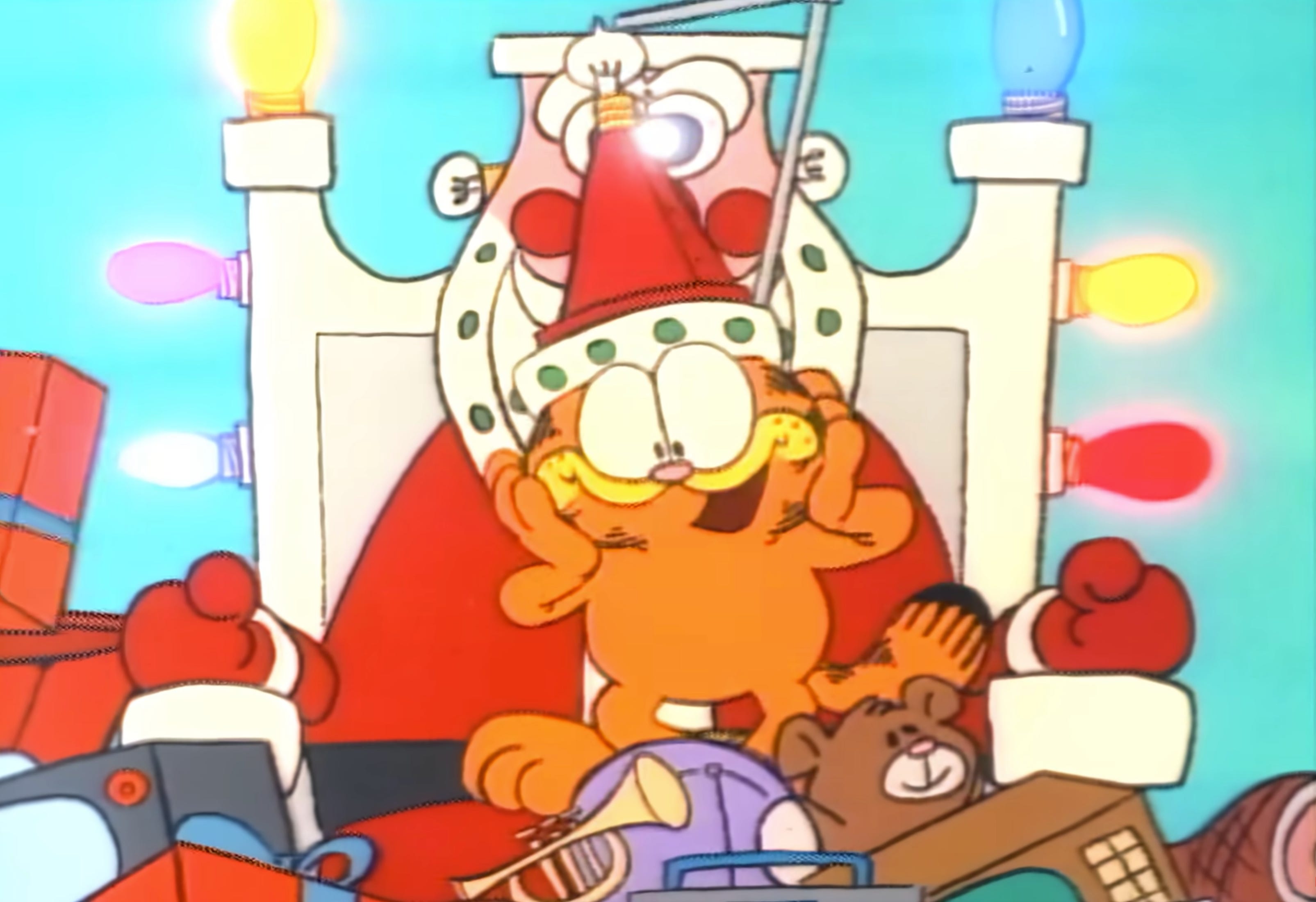
The special begins with a brief cold open. Jon, dressed as an elf, wakes up an uncharacteristically cheerful Garfield, who declares, “Christmas means presents. Lots and lots of presents!” Luring Garfield to the tree with “breakfast lasagnas,” Jon forklifts in a huge giftwrapped box, which falls away to reveal a gaudy, electronic Santa-shaped throne with a metal hat (resembling an electric chair skull cap) and a sack labelled Toys. “It’s the gift that keeps on giving,” Jon exclaims, before sitting on the throne to demonstrate: “This gift giving machine can read your mind. Whatever you think of it will give you!” The cap lowers to Jon’s head, some squeaky electronic sounds play, then the sack shudders and spits out a green bycocket hat. When Garfield takes a turn, the sack produces a handful of jewels, and he quips “Now this is what Christmas is all about,” before generating a deluge of consumer goods—guitars, cameras, TVs, radios, trains, etc. He dives into his sea of products like Scrooge McDuck: “Things, stuffs, gadgets, toys, greed, avarice, I love it.” After a credits song (“Gimme, gimme, gimme”) the screen ripples, revealing that the whole thing was Garfield’s dream.
I had no memory of the rest of the special—just the throne, which I dubbed The Everything Machine. It was my first encounter with an archetypal concept, going back to the mythical overflowing Cornucopia that fed a young Zeus with endlessly refilling food (see also, the Fruit of the Loom Mandela effect). Or, the Brothers Grimm’s Wishing-Table, the wish-fulfilling Kalpavriksha tree of Hinduism and Buddhism, Star Trek’s replicators and holodecks, Harry Potter’s Room of Requirement. The mechanics aren’t always exactly the same, but they share a core idea—generating something from nothing.
Because I’d only seen the show once and had no way to access it after the fact, I never fully knew if it was real, or something I had dreamed up. I was young enough, and the boundaries of my understanding of the world porous enough, that the concept could take on a life of its own. Naturally, it resurfaced around Christmas. I always loved the anticipation of the holiday, cutting out pictures from magazines to make elaborate wishlists of Legos and trampolines and scooters and video games. I didn’t care so much about actually getting presents as I did the act of creative fantasizing. Once I learned of The Everything Machine, my wishlist scrapbooks became redundant. I only needed one thing, from which all else would emerge. Ask, and you will receive.
Even before The Everything Machine appears, Garfield’s dream follows a logic of wish fulfillment, as Jon leads him to the tree with “breakfast lasagnas.” The dream appeals to a fantasy of mastery that runs counter to the creative act of memory—the closure of the gap between desire and outcome. Simply think “lasagna,” and you will get lasagna. It’s a perfectly closed loop. Daydreaming, imagining, chasing—no longer necessary. If Garfield is an algorithm, The Everything Machine is its terminal form.
Garfield Revisited
So thanks to the internet, where it’s only a matter of time before all half-remembered childhood media will be resurrected, I recently rewatched A Garfield Christmas, twentysomething years since I first saw it (almost 40 since it aired). This time I was able to absorb the episode as a whole, beyond The Everything Machine, which actually has very little relevance beyond the intro.
The plot arc is pretty standard for a Christmas special, seeing Garfield shift from Grinch-like materialism to the joy of the giving spirit, and the broad strokes were apparently based on Jim Davis’s own childhood memories. After the cold open, Jon drags a reluctant Garfield from his comfortable bed to his family’s farm in rural Indiana. On the drive over, Jon waxes sentimental about his love for this time of year: “I think the best part is watching the faces of children, and sharing memories of being a child at Christmas.” He launches into a song about his own fond memories, and Garfield cynically undercuts him at every turn (“dad was chopping a tree,” / “chores”).
At the farm, we’re introduced to Jon’s family, and together they cook, decorate the tree, and sing songs. Although Garfield is reluctant, his heart softens when Grandma Arbuckle pets him in her lap and reminisces about her deceased husband in the moonlight. Later, Garfield stumbles across a stack of old letters in the barn, and on Christmas morning, gifts the stack to Grandma Arbuckle. They turn out to be love letters from her husband from when they first met, and she’s moved. At last, Garfield has fully embraced the Christmas spirit, and delivers a heartfelt speech—“It’s not the giving. It’s not the getting. It’s the loving.”
Until now, The Everything Machine was my entire takeaway from A Garfield Christmas, a single image plucked from its context that returns from time to time. It never occurred to me that it was intended to be a plot device, a cautionary tale, a satirical fantasy of infinite consumerism that reveals through contrast the true meaning of Christmas—love, symbolized in the form of handwritten letters. There is something saccharine about the episode, transparently sentimental and manipulative. But from today’s vantage point, its simple appeal to emotion feels refreshing, even radical.
Despite my original intentions, in this writing process I’ve found myself much less interested in thinking about the linear inputs and outputs of The Everything Machine than about my cousin’s reappearances at different stages of my life, leaving books and DVDs behind in his wake, a cross-section of Gen X techgnostica including Philip K Dick, The Matrix, Fight Club, Cosmicomics, Aphex Twin, or Gurdjieff—portals to seeing and thinking in new ways, whose influence on the course of my own life I could only appreciate in retrospect. Or how he got me interested in drawing, or was the first person to employ me as a writer. All these moments were like seeds that would later grow in unpredictable ways, my aunt’s basement a ground zero for cultural currents that still ripple in me, and the world at large. The Everything Machine, with its promise of unlimited abundance, turned out to be a footnote—my way in to thinking about mind and matter, but not my way out. Which may explain why so many of the stories with magically abundant objects contain some kind of ironic catch—the satisfaction is not in the instantaneous fulfillment of a wish, but the gap.
A machine of infinite abundance is a seductive idea. More things, brighter things, shinier things. There is an undeniable excitement to fantasizing about all the new things this machine can do, the things it can create, the things. I was once the dreaming Garfield, swimming through a sea of toys. But time has passed. Seeing what changes and what stays the same, what lasts and what fades, the appeal of The Everything Machine has worn off. Now the most relatable, and aspirational, part of A Garfield Christmas was Grandma Arbuckle’s reaction to her handwritten love letters—the people and the traces they left, and how they continue to live inside us and change us long after they’re gone. I used to read Garfield, watch Garfield, idolize Garfield. Now, I just want coffee.

The World Moves On
I haven’t talked to my cousin in a while. Always ahead of his time, he was an early digital nomad and has spent the last couple decades hopping around Asia. Last I saw on LinkedIn, he’s doing B2B SaaS content marketing with AI.